

NASA Moon Probe Plays Laser Tag With Japanese Lunar Lander
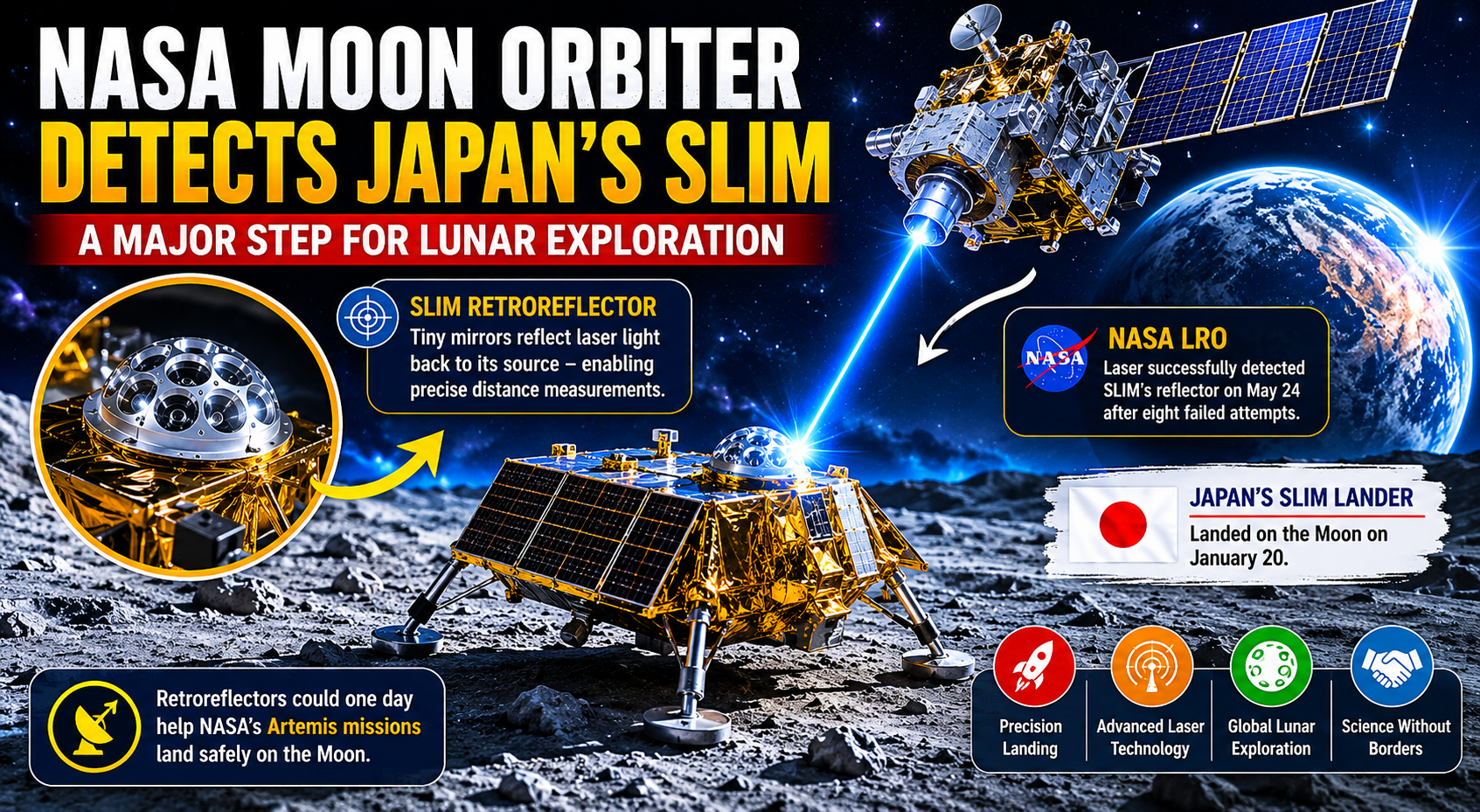
The Moon has become a testing ground for a new generation of precision-navigation technologies, and one recent experiment offered an unusual demonstration: NASA’s Lunar Reconnaissance Orbiter (LRO) successfully detected a laser reflection from Japan’s Smart Lander for Investigating Moon (SLIM).
The experiment was more than a clever “laser tag” moment. It demonstrated how small, passive reflectors can help scientists locate spacecraft and perform highly precise measurements from lunar orbit. It also highlighted the value of international cooperation as NASA, Japan’s space agency JAXA, and other partners prepare for increasingly complex lunar missions.
SLIM’s landing was challenging, and the spacecraft later experienced communication difficulties. Even so, the mission produced important engineering and scientific results, including a demonstration of precision landing technology and observations that are helping researchers study the Moon’s geological history.
NASA LRO Successfully Detects SLIM’s Lunar Reflector
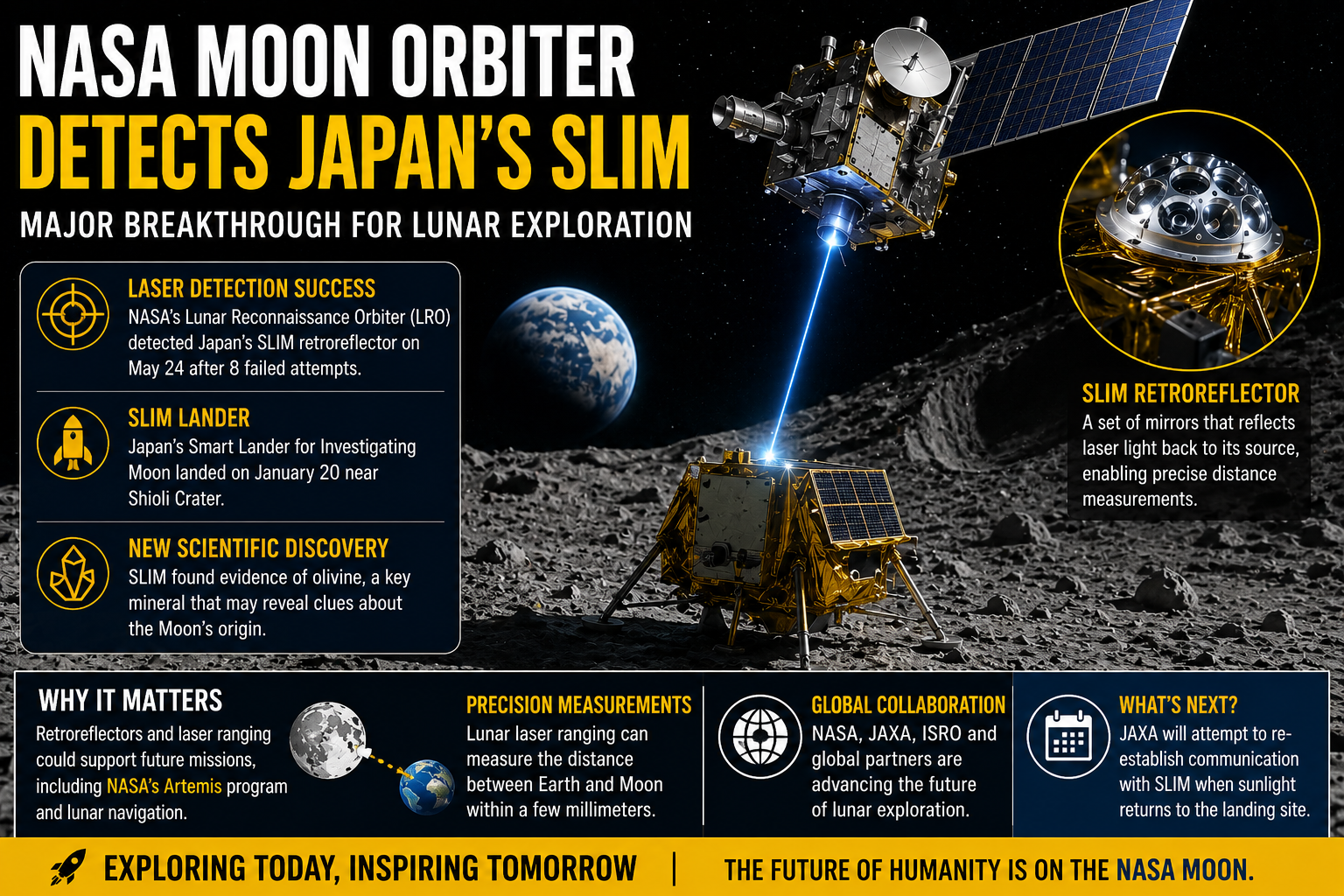
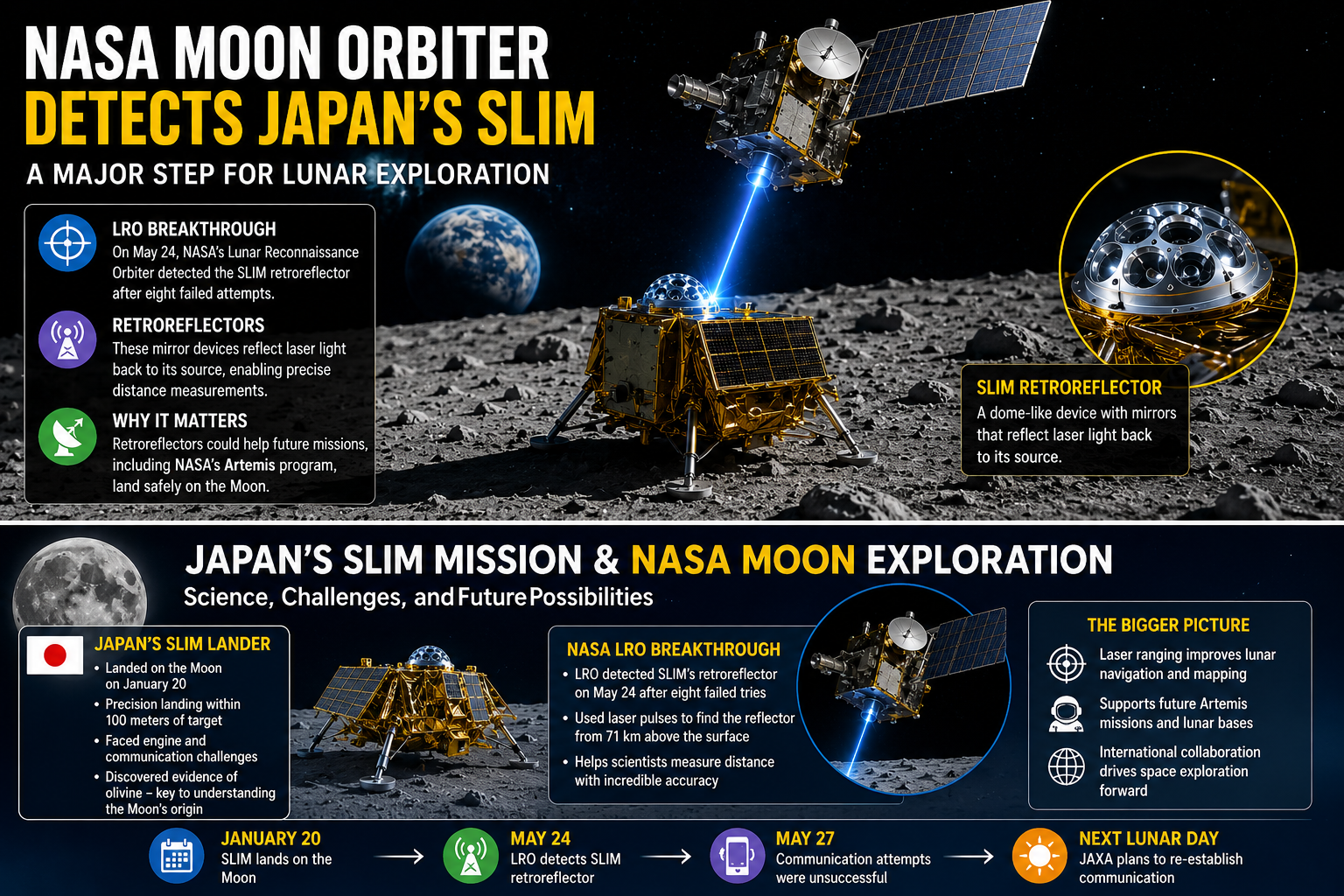
Japan’s SLIM spacecraft landed on the Moon on January 20, 2024, near Shioli Crater. The mission was designed primarily to demonstrate high-precision lunar landing technology, with the goal of reaching a designated area much more accurately than traditional landing systems.
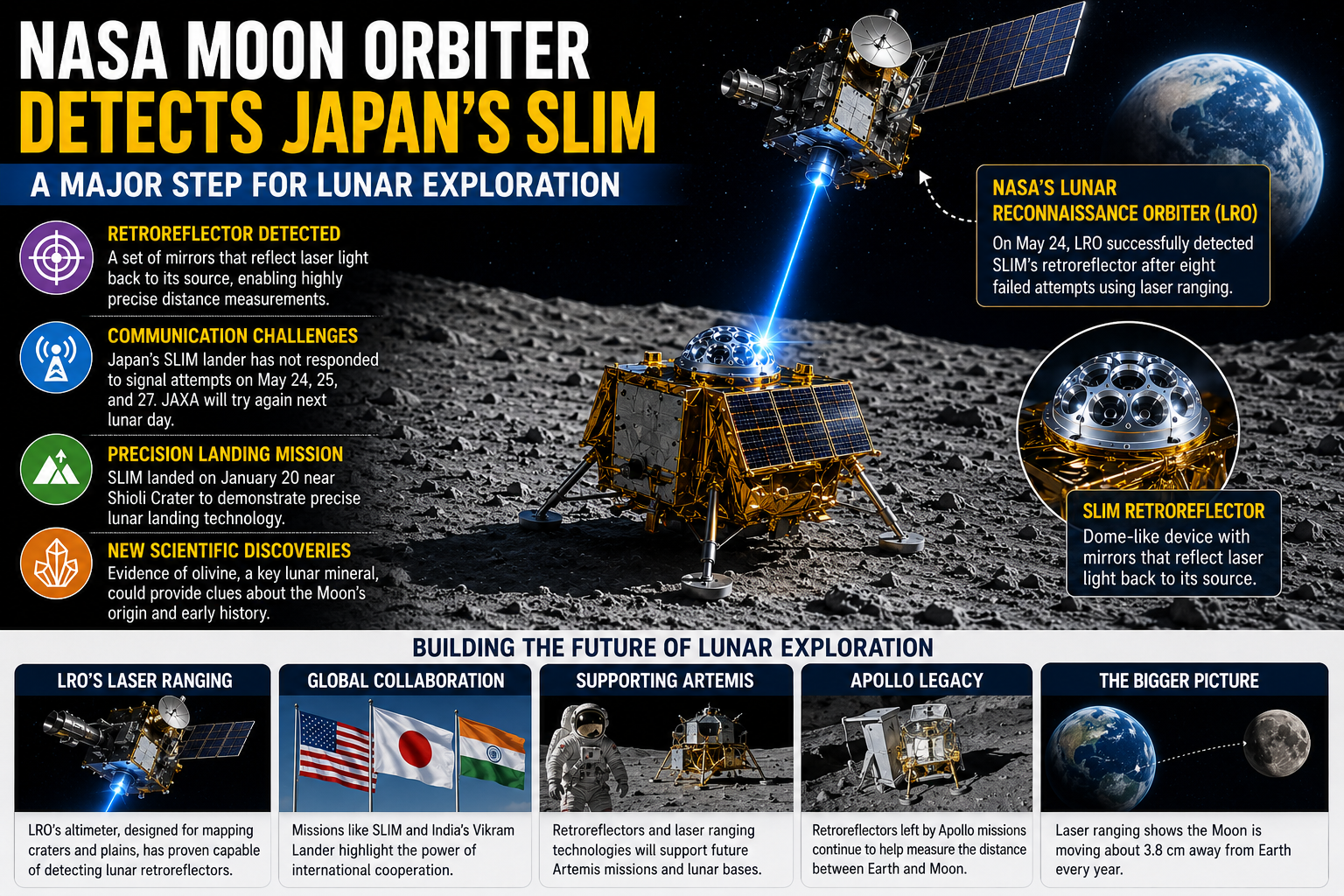
SLIM carried a small laser retroreflector. Unlike an active transmitter, a retroreflector does not require its own power source. Its optical elements are arranged to return incoming laser light toward its source.
NASA’s Lunar Reconnaissance Orbiter attempted to detect the reflector from lunar orbit several times. Initial attempts were unsuccessful, in part because SLIM ended up resting at an unusual angle after landing.
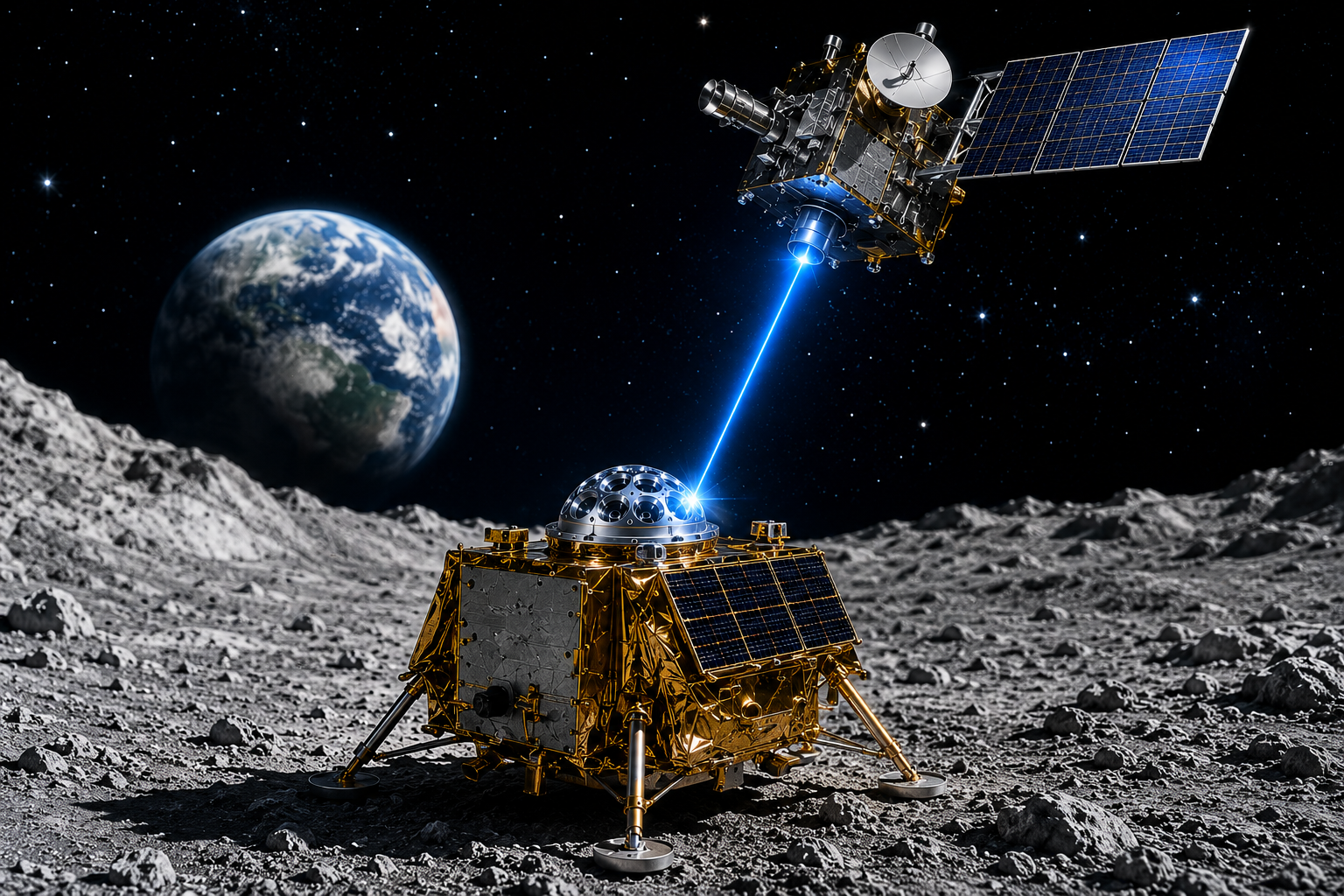
A later observation was successful. NASA reported that LRO’s Lunar Orbiter Laser Altimeter (LOLA) detected laser light reflected from SLIM during two orbital passes.
The result demonstrated that an instrument designed primarily for mapping lunar terrain can also be used for a more specialized task: locating small reflective targets on the surface.
What Makes a Lunar Retroreflector Useful?
A retroreflector is relatively simple compared with a spacecraft’s computers, cameras, or propulsion systems, but its scientific value can be significant.
When a laser pulse reaches a properly positioned retroreflector, its optical elements send the light back toward the originating instrument. Researchers can then analyze the returned signal and use the timing and direction of the reflection to determine the reflector’s location with high precision.
One major advantage is that the reflector can continue functioning without electricity or a communications system.
That makes passive reflectors attractive for long-duration lunar infrastructure. Even if a spacecraft stops operating, its reflector could potentially remain useful for years or decades.
This concept is not new. Retroreflectors placed on the Moon during the Apollo era continue to support lunar laser-ranging experiments. Scientists use these measurements to study the Earth-Moon system, including the Moon’s gradual recession from Earth.
The SLIM experiment builds on that established scientific principle while exploring how similar technology might support future robotic and crewed missions.
SLIM’s Difficult Landing Did Not End the Mission’s Value
SLIM’s landing did not occur exactly as engineers intended.
During the final descent, a propulsion problem affected the spacecraft’s landing sequence. SLIM ultimately reached the lunar surface but came to rest in an unexpected orientation.
Despite the unusual landing position, the spacecraft achieved a major part of its primary technology objective: demonstrating highly accurate landing capability.
The mission was designed to target a landing area with exceptional precision. According to JAXA, SLIM achieved a landing accuracy of roughly 10 meters based on subsequent analysis, substantially better than the kilometer-scale landing uncertainty associated with many earlier lunar missions.
That capability matters because future lunar exploration is likely to focus on increasingly specific locations.
Scientists may want to land near unusual geological formations, permanently shadowed regions, potential resource deposits, or previously identified scientific targets. Future infrastructure could also require spacecraft to land close to existing equipment.
Precision therefore becomes increasingly important as lunar activity expands.
Communication Problems Highlight the Challenges of the Lunar Environment
SLIM’s achievements came alongside significant operational challenges.
The spacecraft experienced periods in which communication with Earth was unavailable. Its unusual landing orientation also affected how its solar panels received sunlight, complicating operations.
The lunar environment is extremely demanding for spacecraft. A lunar day and night each last roughly two Earth weeks, and temperatures can change dramatically between illuminated and dark conditions.
Without a sufficiently reliable energy source and thermal-control system, electronics can struggle to survive the lunar night.
SLIM nevertheless exceeded some expectations by surviving lunar nights that engineers had not necessarily expected the spacecraft to endure for so long.
Its continued operation provided researchers with additional opportunities to study the landing area and test the spacecraft’s systems.
The experience also illustrates an important principle in planetary exploration: a mission does not need to operate perfectly to produce valuable science and engineering lessons.
Precision Landing Could Become Essential for Future Lunar Missions
SLIM’s technology demonstration has significance beyond Japan.
NASA and its international partners are planning increasingly complex lunar missions, particularly through the Artemis program. Future spacecraft will need to reach specific regions of the Moon with greater accuracy as scientific and operational activity increases.
A precision landing system can help reduce the distance between a spacecraft and its intended target.
That could be especially important when missions need to reach areas that are difficult to access, such as steep terrain or regions near the lunar south pole.
Improved landing accuracy could also reduce risks associated with placing multiple spacecraft in the same general area.
For future lunar bases, accurate delivery could become even more important. Cargo landers may need to deliver scientific instruments, power systems, communications equipment, or other supplies near established infrastructure.
SLIM therefore represents part of a broader movement toward more capable autonomous navigation and landing technologies.
SLIM Also Contributed to Lunar Geological Research
Technology was not the only focus of the mission.
SLIM’s scientific instruments collected observations of the lunar surface that researchers have used to investigate the composition and history of the Moon.
One area of interest involved olivine, a mineral associated with the lunar interior. Scientists study exposed or unusually distributed olivine because it may provide clues about material originating deeper within the Moon.
Understanding lunar minerals is important because the Moon preserves geological evidence from an ancient period of planetary formation.
The Moon has experienced far less erosion than Earth, allowing some ancient geological features to remain comparatively well preserved.
Researchers are particularly interested in understanding how the lunar crust and mantle formed and evolved. Such evidence can also contribute to studies of the Earth-Moon system and models explaining the Moon’s formation.
The widely studied giant-impact hypothesis proposes that the Moon formed from material generated after a massive collision involving the early Earth. Lunar samples and remote observations continue to provide evidence that helps scientists evaluate this and other models.
It is important, however, to distinguish between evidence that informs a scientific model and proof of a single explanation. Lunar geology remains an active research field.
NASA’s LRO Turns Laser Technology Toward Small Targets
The LRO spacecraft has been orbiting the Moon since 2009 and has produced an enormous amount of information about the lunar surface.
Its Lunar Orbiter Laser Altimeter, or LOLA, was primarily designed to measure lunar topography.
The instrument sends laser pulses toward the surface and measures the returning signals. By analyzing those measurements, scientists can construct detailed elevation maps of the Moon.
Using LOLA to detect a small retroreflector is considerably more challenging than measuring a broad lunar landscape.
The reflector occupies only a tiny area compared with a crater, mountain, or other geological feature. The spacecraft must also be positioned correctly, and the laser beam must interact with the reflector at a favorable angle.
The successful detection of SLIM therefore demonstrated an additional application for an existing scientific instrument.
NASA previously used a similar approach to detect a retroreflector associated with India’s Chandrayaan-3 Vikram lander.
These experiments show how existing spacecraft can sometimes be adapted for new scientific and engineering objectives without requiring an entirely new mission.
Laser Ranging Could Support Future Lunar Infrastructure
Passive reflectors could become part of a larger lunar navigation system.
Imagine a future lunar surface containing multiple precisely located reflectors. A spacecraft approaching the Moon could potentially use these fixed reference points, alongside other navigation technologies, to improve its understanding of its position.
Such systems would not replace onboard navigation, radar, optical navigation, terrain-relative navigation, or other technologies. Instead, they could complement them.
For autonomous spacecraft, having multiple independent methods of determining position could improve reliability.
This could be particularly useful as lunar traffic increases.
Future missions may include scientific landers, cargo spacecraft, rovers, crewed vehicles, and commercial systems. A reliable reference infrastructure could help spacecraft operate safely in increasingly active regions of the lunar surface.
However, these applications remain prospective. More testing will be necessary before reflector networks become a routine part of lunar navigation.
Artemis Could Benefit From Better Lunar Navigation
NASA’s Artemis program aims to expand human exploration of the Moon and develop capabilities that can support longer-duration lunar operations.
Unlike the short Apollo missions of the 1960s and 1970s, the current approach involves broader international and commercial participation and a focus on establishing repeatable access to the lunar surface.
That creates new engineering requirements.
A spacecraft delivering equipment to a future lunar site must know where it is, where it is going, and whether the destination is safe.
Precision landing, terrain-relative navigation, optical navigation, radar measurements, and potentially passive surface references could all contribute to that objective.
The lessons from SLIM are valuable because they demonstrate how spacecraft can combine sophisticated navigation with relatively small and simple surface technologies.
Future missions will likely use several complementary systems rather than depending on one technology alone.
The Moon Is Becoming an International Science Laboratory
The SLIM-LRO experiment also reflects the increasingly international nature of lunar exploration.
Japan, the United States, India, China, European partners, and commercial space companies are developing different lunar capabilities. Each mission contributes data and engineering experience that can influence subsequent exploration.
Japan’s SLIM mission is a good example.
Although its primary objective was national and technological, its results have relevance for the wider scientific community. NASA’s LRO observations of SLIM similarly demonstrate how one country’s spacecraft can contribute to understanding another country’s mission.
International cooperation can reduce duplication, expand scientific opportunities, and allow researchers to combine measurements from different spacecraft.
As lunar exploration becomes more sophisticated, those relationships may become increasingly important.
Why the “Laser Tag” Experiment Matters
The phrase “laser tag” makes the event sound playful, but the underlying science is serious.
NASA’s LRO was able to identify a small reflector attached to a Japanese spacecraft from lunar orbit. That result demonstrated the precision of modern lunar measurement systems and provided another example of how passive technologies can remain useful long after their host spacecraft stops communicating.
The experiment also connects several major areas of lunar exploration:
- Precision navigation: helping spacecraft determine their location more accurately.
- Lunar science: supporting measurements of the Moon’s surface and interior.
- Mission resilience: showing how spacecraft can deliver useful results despite operational problems.
- International cooperation: combining NASA and Japanese capabilities.
- Future infrastructure: demonstrating technologies that could eventually support a more active lunar environment.
None of these results means that the Moon already has a complete navigation network. Instead, they represent incremental steps toward technologies that future missions could build upon.
What Comes Next for Lunar Exploration?
The next phase of lunar exploration is likely to involve more spacecraft, more scientific instruments, and increasingly precise operations.
NASA’s Artemis missions are expected to play an important role, while Japan and other international partners continue developing their own lunar capabilities.





здесь [url=https://trip20.us/]сайт трип скан[/url]
спецоценка условий труда стоимость https://sout095.ru
allows you to view instagram allows you to view instagram .
watch ig watch ig .
реабилитационный центр лечение алкоголизма реабилитационный центр лечение алкоголизма .
view and download instagram stories view and download instagram stories .
эскорт в москве эскорт в москве .
view instagram followers anonymously https://www.anoninststories.com .
https://evakuator-mow.ru http://evakuator-mow.ru/ .
курс доллара к тенге астана курс доллара к тенге астана .
новые бизнес идеи новые бизнес идеи .
Вывод из запоя на дому в Алматы fizioterapijakeskic.com .
бизнес идея бизнес идея .
скорая наркологическая москва скорая наркологическая москва .
Nasa moon mission nice